Unlike other countries of the world, in Vietnam the minority of vehicles, after scooters, motor bikes, taxis and buses, are cars. And it seems the majority of those cars are large four-wheel drive vehicles. On Monday morning, all we wanted was a minibus to take us to the Mekong Delta, the Nine Dragon River Delta. We were standing in the foyer at Rick and Lans’ office at 7:30am and at 8am we started to get worried, but just as the fumes were starting to suffocate, the bus finally turned up. There were no other passengers on board and we headed out of Saigon without picking up anyone else. After fifty minutes, we finally started to see acres of green fields, mainly rice fields, which was quite a relief after all the concrete. It was a bucking-bronco of a ride. Every stretch of road that crosses a river, and there were many of them, has an enormous seam as you drive on to a bridge and again as you come down. Being the size of speed bumps and with the speed of the bus, we sometimes literally took off; thank goodness the seats were well padded. All over the world, I always enjoy looking out of the windows as we travel, to see what’s different and what’s going on out there. We were surprised to see hammocks hanging in every roadside café, of which there were many. In fact we think we saw more hammocks here than we ever did in Mexico. After about three hours we crossed some massive bridges reminiscent of the Dartford Bridge in England and far bigger than the Anzac Bridge in Sydney. The rivers underneath were always muddy and wide, with clumps of large leaved water hyacinth slowly floating down river.
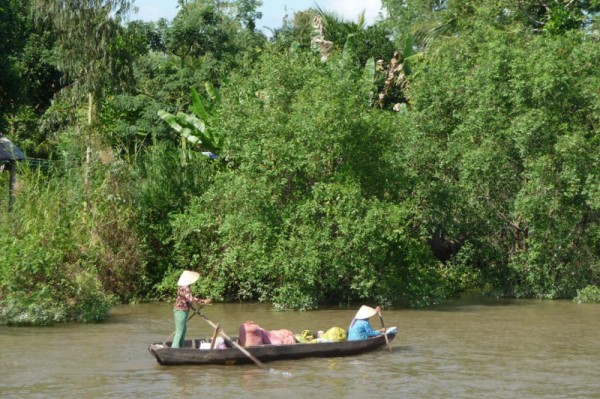
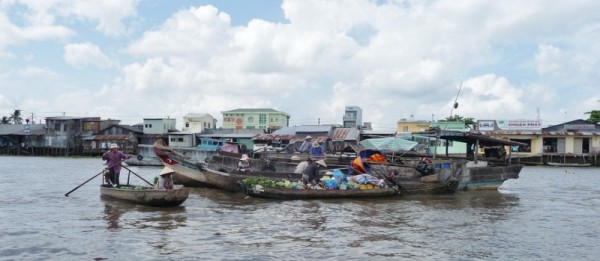
At 11:30am, on arriving in Can Tho, we were met by our guide Tsuy and we boarded a small boat. The driver took us out in to the centre of the river and we floated amongst the fruit and vegetable traders. The floating market starts very early, every day (except New Year’s Day), so by now most of the boats had left, though there were still plenty for us to see. There is a tall bamboo pole on the front of each boat and tied to the pole is a pineapple, or a cabbage, whatever fruit or vegetable that trader is selling. Some even have a veritable fruit salad tied to the pole if they are selling more than one type. These traders are the wholesalers who bring their produce from their farms by boat and they then stay at the market for three days to sell their produce to local shops before heading back to their farms.
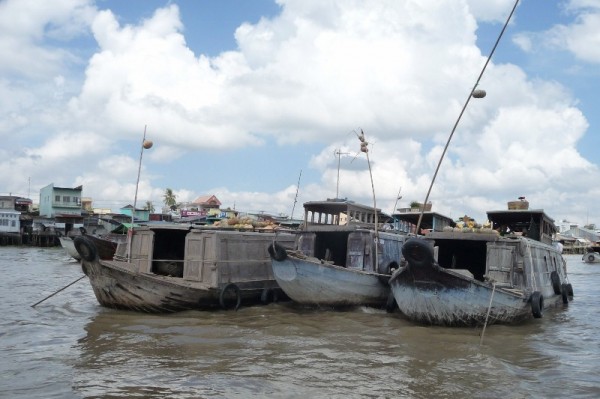
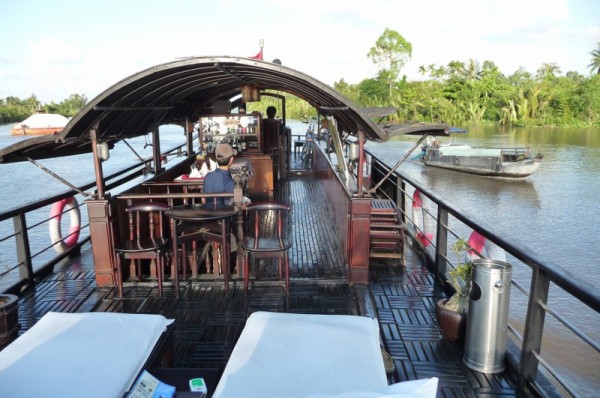
Our boat then left Can Tho and motored south down the Bassac River to take us to our cruise boat. When we boarded the empty mini-bus in Saigon and the small boat in Can Tho, we wondered if and when more people would be joining us. But, as we climbed aboard the Mekong Melody, our small cruise boat, we were told that we were the only guests! We were given room no.101 and the only other room, no.102, remained empty. So we were grandly outnumbered on board by the crew of five. Mr Captain steered our boat through the busy waterways of the Mekong Delta. Mr Cook managed to dish up the most delicious food. Mr Engineer was around and about and doing his thing. Tsuy acted as guide, waiter and interpreter. And then there was The Boy; he seemed to be general helper and also the reflexologist. On the first evening, before dinner, we were both treated to a foot bath and foot massage. What a treat.
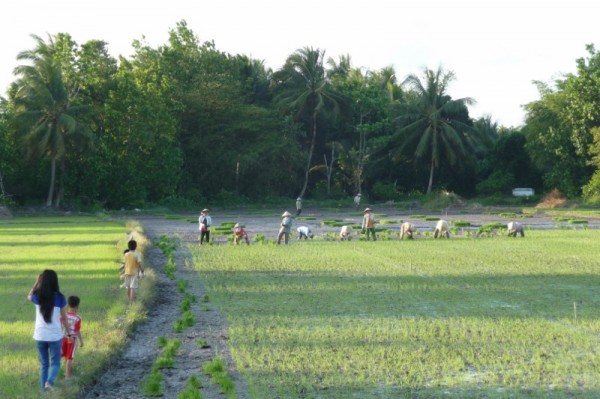
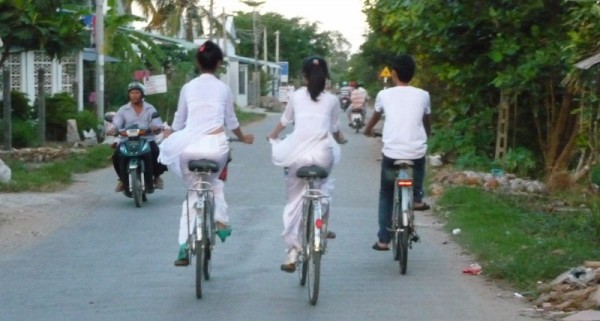
Prior to the foot massage and dinner, the two of us and Tsuy were put ashore with bicycles. We cycled about 10 kms through numerous rice fields and villages. Tsuy pointed out fruits and flowers and explained a few things along the way, while children constantly shouted hello and waved to us. Our first introduction to the Mekong countryside was rather lovely.
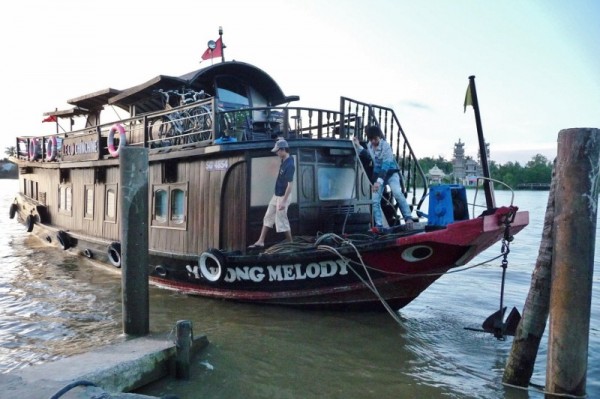
The only thing that wasn’t so great about the countryside, was that after dark, the non bitey rice flies arrived and flew about the deck of the boat, constantly landing all over you. But Tsuy helped ‘collect’ some by hanging up wide strips of Sellotape and he ended up with loads of flies stuck to them by the end of the evening. We had already had a six-course lunch, but after a beautiful sunset we were served up an enormous five-course dinner. We felt like a couple of stuffed Strasbourg geese. The moon was almost full that evening and everything around us was pitch black. There were only a few lights on the riverbanks and the only sound was the chugging of our boat’s motor, a few birds and sometimes some music being played on the shore. To cool off we had cold showers before slipping under the crisp white sheets for a good night’s sleep.
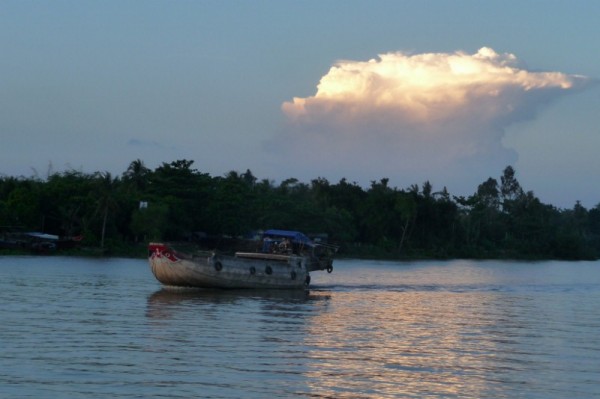
We were woken at 6am by the anchor being raised and the motor starting up, but we lazed in our bed for another hour just watching the passing scenery through the window. Breakfast continued in the ‘multiple courses’ tradition with copious amounts of omelettes, sausages, cheeses, tomatoes, cucumbers, bread, jam, banana pancakes, yoghurt, rambutans, finger bananas and ginger teas. Then, with very full bellies, we were ferried across the river to go for a walk through a village.
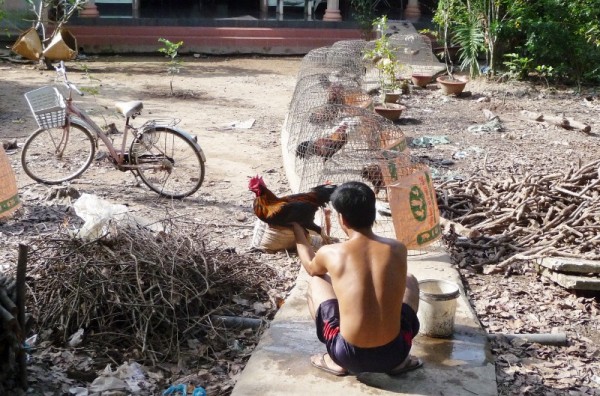
There were no rice fields here, but a huge variety of fruit trees; pomelo, durian, jackfruit, longan, rambutan, breadfruit, starfruit, bananas and many others that we didn’t recognise. We also had fun playing with the mimosa plants, which Tsuy called ‘shy lady plant’ because the leaves shrink back when they are touched. There were also very many colourful cockerels, some wandering about and others kept under woven basket domes. One was receiving a very thorough wash and preening from its owner and its feathers shone vibrantly in the sunlight. Every house had one, some had almost a dozen; this was obviously big business. Tsuy informed us that “cockfighting is illegal, but there is big prize”; not sure where the police are….?!
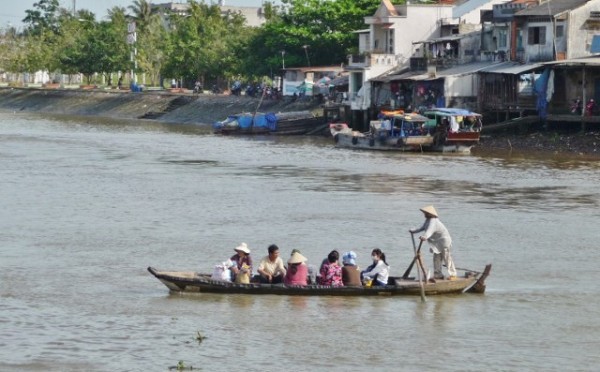
Back on board the Mekong Melody, we cruised on down the small river which we had anchored in overnight, to join a second large river, First River or Tiền Giang. Turning left, we slowly cruised northwards to Sa Dec. The two of us lay on the sun beds, snoozing, dozing and trying to read, in between watching the activity of the passing boats. Lunch arrived in the form of another enormous banquet, again beautiful presented. The banana flower salad was my favourite today. The flower was chopped up finely and pieces of shredded chicken were laid on top, tiny peanuts were sprinkled all over and the whole lot was soaked in a sugary lime juice. It was refreshing and delicious.
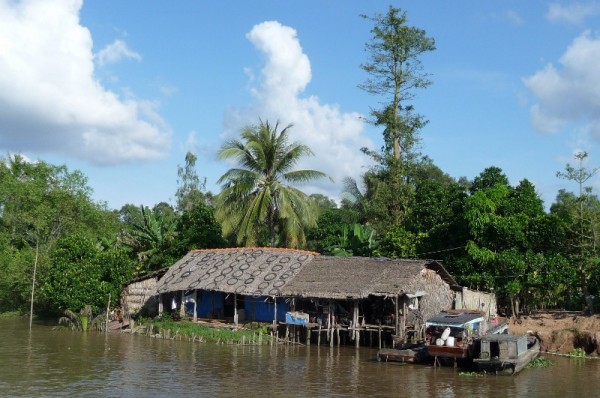
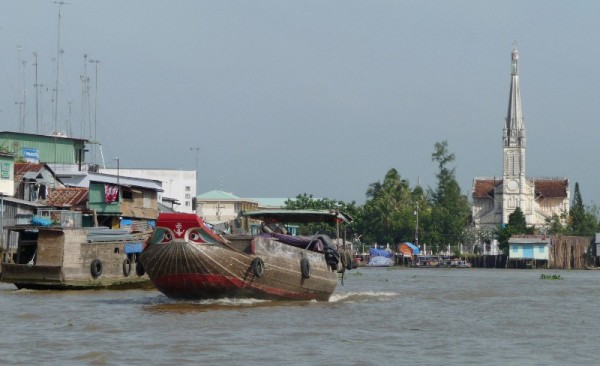
The scenery on the Mekong Cruise was not exactly exciting; it’s more a ‘look at what life is like’ in this area of Vietnam. I found it rather sad seeing so much poverty in the shacks along the way. It made me feel embarrassed travelling in an air-conditioned room with bathroom and electricity, or sitting on beautiful chairs being fed gourmet food as we passed them by. I just have to be glad that I am the one on the boat and not the one eking out an existence on the river banks. Hopefully our tourism is at least giving some of them a better, more interesting life. Meanwhile Rodney continued to be amazed by the lack of ‘road rules’ on the waterways. The boats weave about, passing on whichever side seems easier. Just like the traffic on the roads, everyone seems to miss each other; at least we haven’t seen any mishaps …..yet! Maybe it’s the eyes that are painted on the front of most of the boats. They’re supposed to scare away the river monsters, but perhaps they prevent river crashes too.
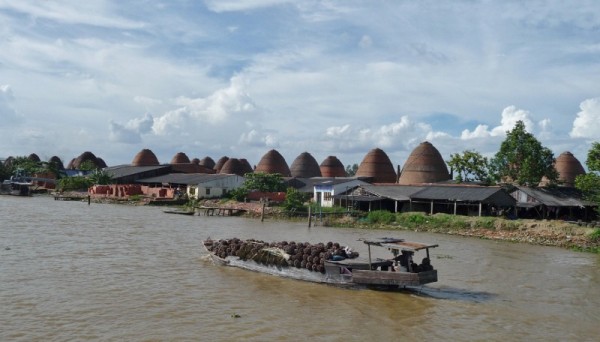
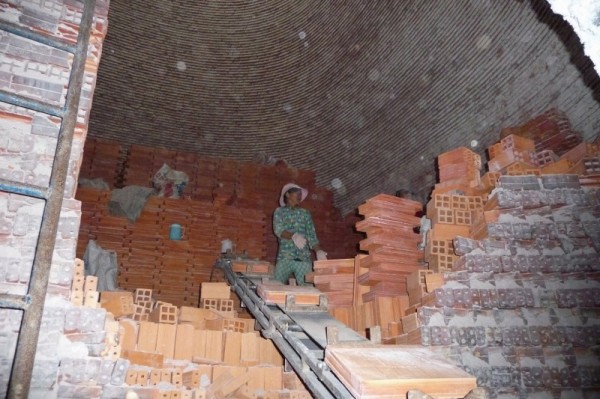
After 3pm we arrived near Sa Dec and were ferried across to a brick factory on the eastern shore. The brick kilns are enormous domes made of layers and layers of small bricks. With Tsuy, we shuffled through past workers pouring rice husks in to the fires to stoke the ovens and other workers were removing the piles of hot ash which are then sent to be used as fertilisers. One group of women were inside one of the kilns removing the gigantic layers of baked bricks. Two men were slowly mixing a huge mound of lumpy clay with a couple of shovels; that looked like an impossible job. And amongst it all there was a constant stream of men and women with wheelbarrows moving ash, rice husks, clay, prepared bricks and tiles, and also the baked finished product. Everything came in on boats and everything left again by boats. It was a fascinating hive of industry. We clambered back over the pile of broken bricks and tiles that formed a makeshift jetty to board our boat again.
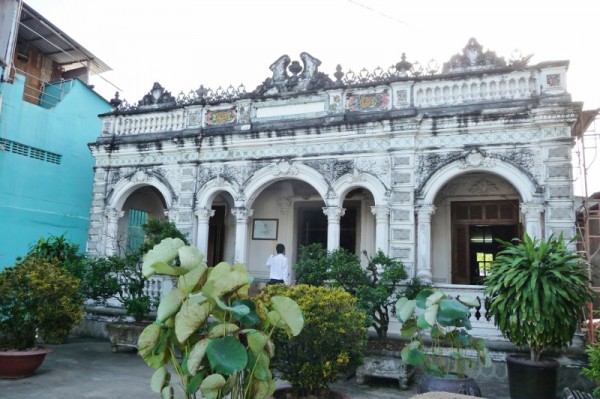
From there we travelled up to Sa Dec and pulled up at some slippery steps. Some cash was handed to a passing policeman; not sure what that was about? We then visited the old house where a man called Huynh Thuy Le used to live. He was the eldest son in a rich Chinese family and in 1929, at the age of 27, he had an affair with a French girl, Marguerite Duras, who was only 15 years old. It’s a very sad story as they weren’t allowed to marry, because she wasn’t Chinese, she wasn’t rich and they had lived together for a year in sin. He finally married someone else and had five children. Marguerite sailed to France married a Frenchman and had one child. Apparently Huynh tried to contact her to tell her that he still loved her, but she refused ever to speak or see him, after she left Vietnam. She wrote a book ‘The Lover’ in 1984 and a movie of the story was made in 1992, I think I would like to get a copy.
While in Sa Dec we also wandered along the embankment staring at all the fruit and vegetables laid out in baskets on the ground. At the far end of the market, the stalls changed to purveyors of fish and meat, plus one delightful tray of ready-prepared frogs and rats !!!
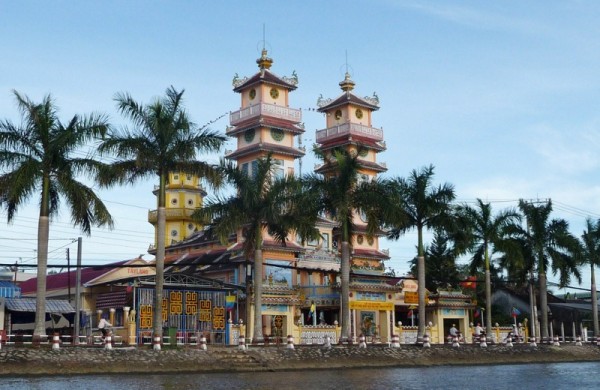
The next stop was on the opposite side of the river where we visited a few garden nurseries. It was lovely to see so many exquisite flowers and quite amazing to see how they piled up the plants, with only newspapers wrapped around them, from floor to ceiling in the back of trucks to be delivered all over Vietnam. Our final stop for the day was at a Cao Dai temple, an interesting religion that seems to take aspects from various religions, including Buddhism, Taoism, Confucianism, Christianity and Islam. They believe in one God, but also Buddhas, sages and saints. Amongst many of the people they revere are Shakespeare, Victor Hugo, Joan of Arc and Lenin…..!!?. After viewing the overly decorated altar, we climbed up an extremely narrow concrete staircase to the top of one of the towers, probably about 40 metres up. From the balcony on the top, with the sun setting low, we could see over the river and a lot of the city below.
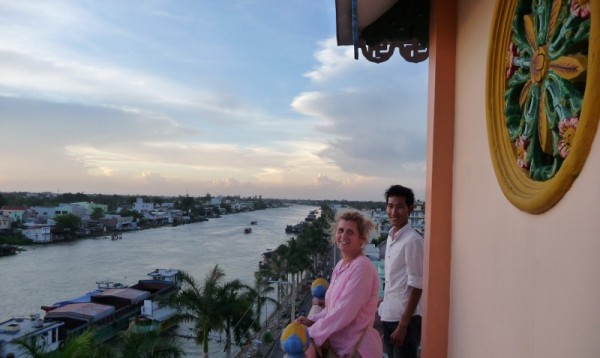
We opted for another cold shower on board before another six-course dinner and then after a short time relaxing up on deck, watching the lights on the other boats swinging about, we climbed downstairs to our cabin for an early night.
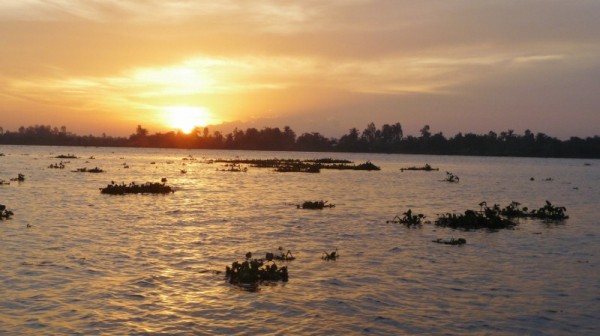
We slept well and woke up to the noise of the anchor and engine again, this time before 6am. I pulled up the blind to see where we had moored overnight, as we had motored quite a way in the dark until well after dinner. We were right in the middle of a very wide section of the river, a bit more attractive than the previous night when we were moored next to a gravel factory. After breakfast, packing and goodbyes to the crew we boarded another small local boat, along with Tsuy.
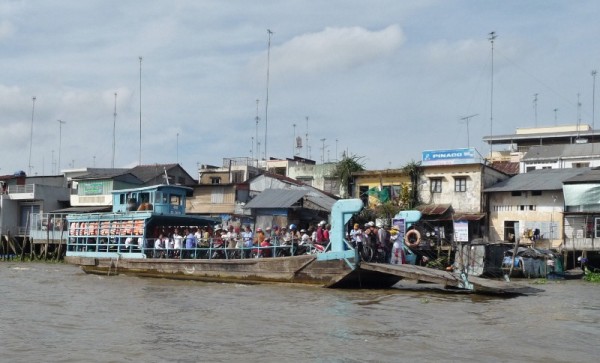
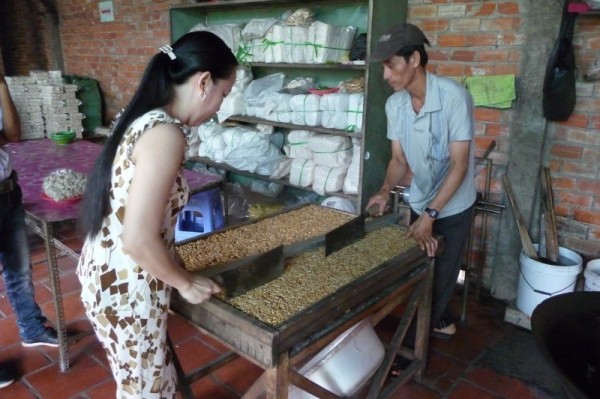
We crossed the bay at Cai Be and passed another floating market, finally pulling up at a sweet factory. We were shown all the various stages of different sweets being made and the smells of banana, toffee, coconut, etc. were wonderful. Everything they did was so simple, with very little mechanisation. Near the front, three people were making some sticky peanut toffee. One spread and squashed the ‘goo’ into long wooden tracks about 2cm by 1 metre. As each strip solidified, he lifted them and laid them on a large slab where upon a girl chopped them into squares and tossed them on to a table. Another girl then wrapped each square in a tiny sheet of rice paper and then a sheet of cellophane. About thirty sweets were then placed in little cardboard boxes and wrapped again. They were so fast and yet managed to keep chatting away as we watched them. At the rear of the factory, black sand was put in to a large wok which was then heated over burning rice husks. When it was extremely hot they tossed in a bowl full of rice. As the rice got hot, the husks peeled away and the rice popped and jumped like popcorn. The whole lot was then tipped in to a fine sieve so that the black sand fell in to another wok. The rest was then passed through a huge sieve so that the husks fell to the floor and were swept back to keep the fire burning. The remaining popped rice was then mixed with a sticky caramel substance and squished down into a big wooden frame. It was then pressed down, cut into small blocks and packaged, ten pieces at a time, into cellophane bags. I have to say, they were delicious and I would have bought some, but it took at least an hour to remove the one I tried from my teeth.
We sat down for a while to drink green tea with Tsuy and I loved the way the teapot was kept inside a coconut to keep it warm; a bit different from the knitted tea cosies we normally see!! We quickly browsed the inevitable gift shop at the front of the factory; it was our first chance to browse in a shop and we bought some little bamboo dragonflies which will balance on the tip of your finger. The boat then whisked us further up the river and down a narrow canal to an old dark wooden house. Mr Kiet’s House was built in 1838 with 100 columns of precious wood supporting the structure. It is right in the middle of an orchard which has the most enormous variety of fruit trees, including sapodilla, longan, rambutans, durian and everything we had seen in the markets.
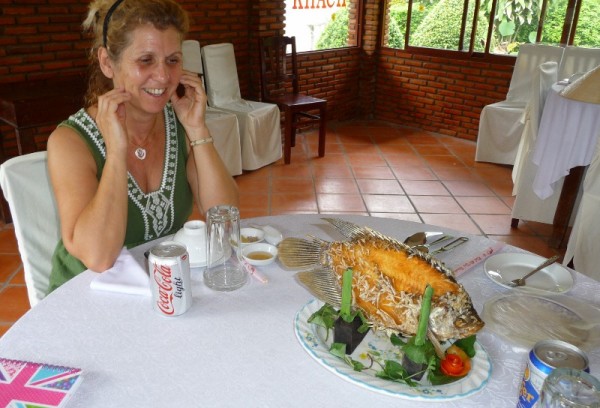
The boat finally dropped us and our suitcase at a local restaurant, back on the edge of the main river. The restaurant comprised of many small buildings and huts set among lovely landscaped gardens. The elephant ear fish was presented to us with all features intact, upright, propped between four tiny wooden posts….. We’ve never seen anything like it and we weren’t sure how we were going to dismantle it. Fortunately, the waitress reappeared and proceeded to remove clumps of the flesh and skin with just a couple of chopsticks; leaving the head, tail, skeleton and other side of flesh and skin still upright; it was an impressive skill. She wrapped the meat and crispy skin with pineapple slivers and cucumber slices in rice paper and pointed to the correct dip on the table. She then peeled massive langoustines and pointed to the bowl of pepper and salt mixed with lime juice. In her absence, we thought we would strip the other side of the fish, but being less skilful, we lay it down to get at the flesh. We were reprimanded, we thought because as guests, we should have waited for her to do it. However we have since found out that in Vietnam, it is not good to turn over a fish on a plate because it is bad luck for the fishermen; it may cause their boats to rock and turn over. Having filled our bellies with all of the above, we then sighed as a plate covered in beef, capsicum, tomatoes and chips arrived, followed by a bowl of half peeled rambutans. We both decided that this really had been a veritable gourmet trip around the Mekong Delta and we’ll never again turn a fish over when eating it.