
Thursday 15th June
The alarm went off at an early hour. Eurgh. The sun had already risen, but was still low on the horizon and definitely worth another photo.
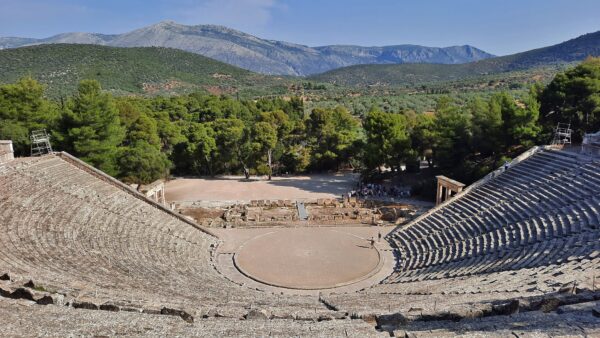
At 8:15 am we got our ‘rolling tortoise’ back on the road and headed to Epidavros; the ancient ruins on land, not the ones underwater. By 8:45am we were walking into the very impressive theatre. It is set underneath the shadow of three mountains and faces the Asclepios Valley. It can accommodate up to 14,000 spectators. I could have sat there at the top for quite a while staring at its magnificence and imagining being there back in 4 BC, but the heat was already starting to build and there was more meandering to be done.


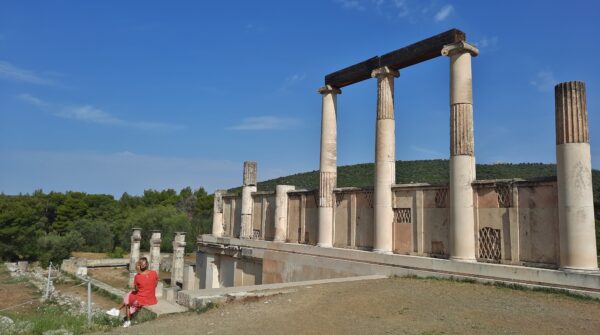
The Sanctuary of Asclepios, the gymnasium and the stadium were set apart from the theatre through a small grove of olive trees. As Mike would say, “another load of rubble”, but it was interesting to read the signs describing what happened there, back in ancient times. Asclepios was the son of Apollo and was trained in the healing arts. He became so proficient that he was able to resuscitate the dead, which apparently upset Zeus and Hades. They were jealous of a power that was reserved only for gods. Grumpy Zeus sent a thunderbolt to strike Asclepios dead and his body was reported to be buried at Epidaurus. Thus started a cult where sick people came to Epidaurus. for purification and cures. They would sleep in a ‘sacred’ dormitory and be cured by Asclepios appearing to them in dreams. Priests would translate the dreams into treatments accompanied by exercise, relaxation and bathing. Sounds a little bit like a modern-day spa.
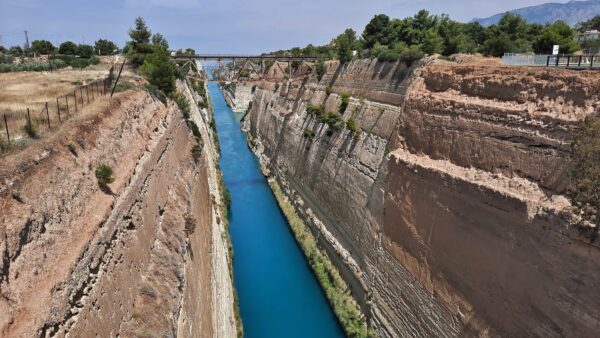
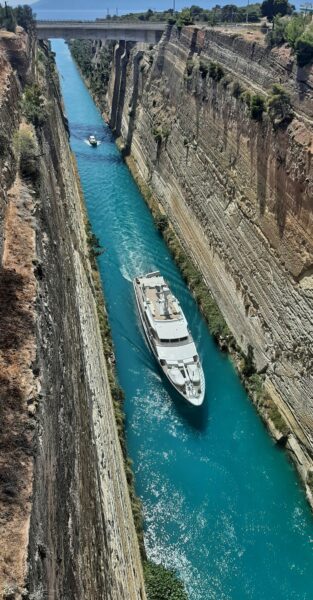
Next stop on today’s agenda was to take a look at the Corinth Canal. Gosh, it really is an enormous man-made gash through the rock. It was deeper than I had imagined, and narrower too. It costs €233 to pass through it once, making it the most expensive stretch of water in the world per kilometre. Approximately 1,500 boats per year use its 6.3 kilometres length, which would provide quite a good income, although the maintenance must be incredibly expensive. Its sides are almost vertical and due to numerous landslips, it had been closed for a while this year. We were very lucky to enjoy watching two boats slide their way through the turquoise water as it had only just reopened on June 1st.
Diakofto was our next stop to buy tickets for a train. Annoyingly, we timed it badly; the ticket office had just closed for lunch until 2:15pm. So we used the waiting time for eating lunch. Mine was an interesting choice, not sure if it’s a traditional Greek dish. One slice of toast spread with a thin layer of avocado, topped with tiny cherry tomatoes. And a second slice covered with avocado, cottage cheese and a fried egg on top. Add some lettuce on the side and it was actually a nice change from the same old same old. We purchased our two return tickets for tomorrow and drove 20 minutes back to Camping Akrati, a long narrow, tatty campsite set beside another pebbly, stony, gritty beach. When we walked down to the beach after a long nanna nap, the wind had come up and there were small rollers of surf crashing onto the pebbles. First time we’ve seen a wave in Greece.
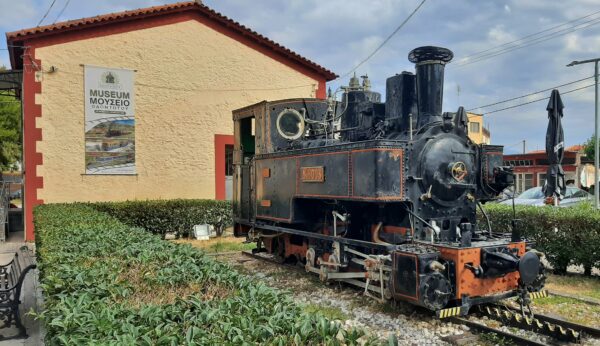
Friday 16th June.
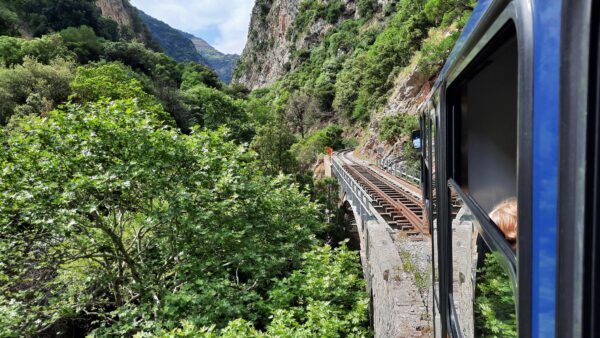
Somebody else’s alarm woke us up too early today. Ah well, plenty of time for breakfast and to get on the road at 9:00am. We left our ground sheet, table, chairs and bikes on our pitch and headed back to Diakofto. At 9:52am, the Odontotos, a.k.a. rack or cog railway arrived and quickly filled up with tourists. Off we went. This is the narrowest gauge in Europe (0.75m) and is also considered to be one of the most scenic train journeys in Europe. It takes about an hour to wind its way up through the Vouraikou Gorge. It runs for 22 kilometres along a vertiginous route through tunnels, along overhangs, across bridges and viaducts and where the incline is steeper than 7%, it becomes a cog railway.
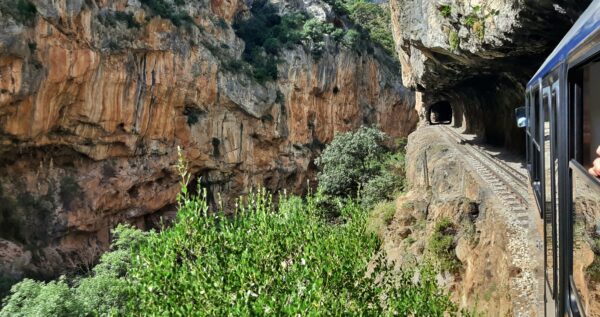
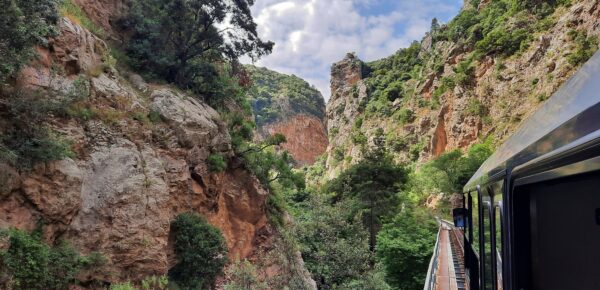
The gorge itself is spectacular; high sheer cliffs riddled with caves and the railway line crosses from one side to the other, high above the River Vouraikos. What worried me was its age. Having been built in 1896, I hoped that it had been superbly maintained since then!!!
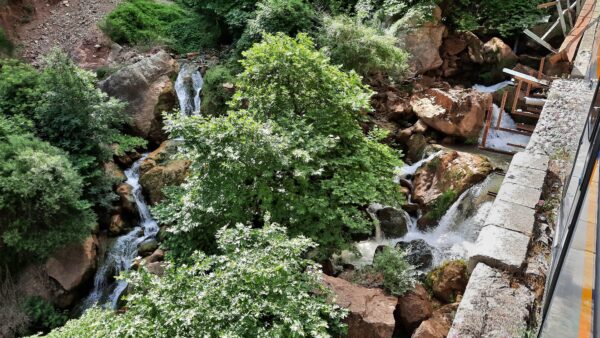
The town of Kalavryta was quite nice but has a very sad history. We had 2½ hours to spend there. We walked through the main street and then slowly hiked up very steep roads to The Place of Sacrifice of Kalavryta.
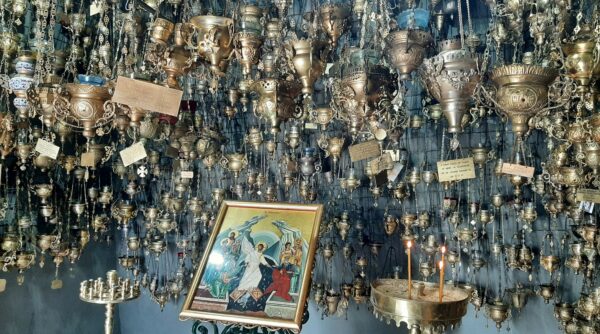
Early in the morning of 13th December 1943 German soldiers moved all the villagers to the primary school. They separated the men from the women and the children under 13, then the men were marched up to Kapi Ridge where they had to watch their village being destroyed and the school set on fire with the women and children still inside. Sometime after midday two flares were sent up as a signal to execute all of the men. A total of 465 were shot and only 13 survived. Many of the women and children died in the fire, but quite a few managed to escape. But then the survivors had nowhere to live and spent two days burying their families. Set under Kapi Ridge is a chapel with ornate bronze lanterns hanging from the ceiling; one for each of the dead.

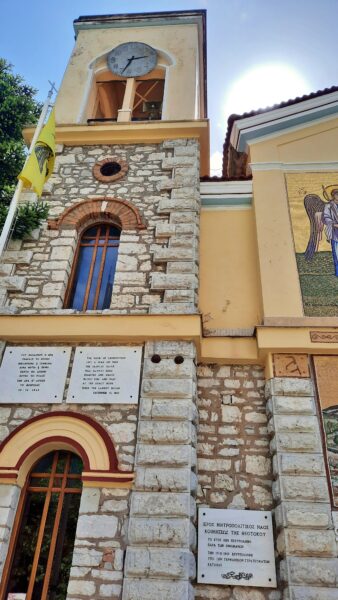
The rebuilt primary school Is now a museum to the Holocaust and the front doors remain shut, never to be opened. One of the clocks on the Cathedral Church of the Virgin Mary has been stopped at 2:35pm considered to be the time when the guns fell silent.
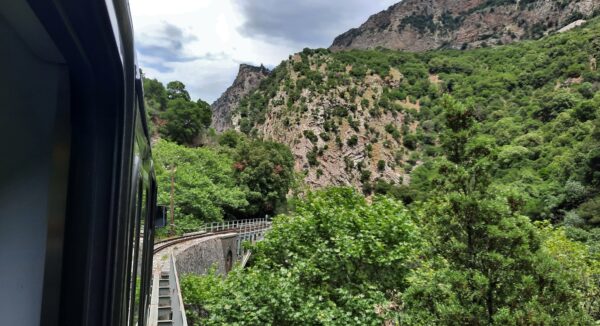
In a slightly more sombre mood, at precisely 13:37pm, we boarded the train again and enjoyed the dramatic scenery all the way back down to. Diakofto. The scenery changed with every twist and turn of the train. It’s impossible to imagine how anyone could have come up with the idea of putting a train track up such an amazing gorge, way back in 1896, but we’re very glad they did. Any photos we’ve taken do not do it justice. It had to be experienced. We had found a wow.
Your most incredible day so far. So emotional, and a railway thrown in!